
Most teams already personalize something: an email subject line, a retargeting ad, a homepage banner for returning visitors. Far fewer personalize the journey. A prospect comparing vendors and a customer three months into onboarding often get the same article, the same nurture email, and the same next step, because nobody decided what each stage actually needs.
The expectation is clearly there. Twilio’s 2025 State of Customer Engagement Report, which surveyed more than 7,600 consumers and 637 business leaders, found that 75% of businesses report increased customer spending from personalization, while 84% of consumers want control over their personalization settings. Customers want relevant content, and they want it on their terms.
Below, we’ll cover how to create personalized content for every stage in the customer journey: find out what’s relevant, map it to the stages, decide what changes at each one, segment by need, keep the system manageable as it grows, and measure what works.
1. Understand what relevant content actually looks like
When it comes to creating relevant content for your users and customers, the first step is probably quite obvious: figure out what’s relevant to them.
To achieve this, whoever creates the content strategy and writes the content needs to have regular, open dialogue with your audience. In short, you need a customer listening program.
If your content team is now tasked with customer listening, it’s best to limit the scope of what that should look like—otherwise, customer meetings can easily suck up a lot of time. To start a streamlined customer listening program, use these four steps:
- Sit regularly with the CX team
Your content team should sit with the CX or CS team on a regular basis (try once a month to start). Have them listen in on customer calls—specifically looking for customer questions that marketing can solve earlier in the journey with well targeted content. See which topics come up repeatedly and which formats customers are interested in (videos, how-to articles, etc.).
- Create representative customer focus groups
If your company has clearly defined personas or ideal customer types, use those to create customer groups that reflect those personas. Meet with these focus groups about once a quarter to get feedback on company messaging, content, campaigns, and ideas. Your content team should drill into some of the focus areas and pain points they learned about in their CS calls.
- Aggregate customer feedback
You likely have several different customer feedback platforms: NPS scores/comments, review sites, support tickets, etc. Aggregate that data in order to look at trends in topics, problems, and FAQs. Once you identify themes, drill down into individual responses for more information and follow-up for feedback.
- Focus on being useful
Marketing teams often fall prey to pushing their product and brand above all else. But customers are after something entirely different: value. They want help with their problem, an answer to their question, or actionable advice. The goal of your customer listening program should be to provide your audience value, not pushing your products.
Listening tells you what customers say. Pair it with behavioral customer journey data, which shows what they actually do on your site, and you have a far more reliable picture than either source gives alone. All of that knowledge can be structured into a customer journey map, which will help your content team assess at which stages each piece of content is appropriate.
2. Create your customer journey map and add in content
When you take a look at your customers’ journeys, you’re essentially mapping out the flow each persona or customer group takes when making a purchase or becoming a customer. When you do that, you can see the pain points, obstacles, and smooth areas of a customer’s journey and address them as necessary.
You and your content team are probably both familiar with the traditional marketing funnel and the habit of creating top, middle, and bottom funnel content. But the funnel is very static, and not nearly as flexible as the actual process of buying a product.
As McKinsey and others have pointed out, the decision making process is actually more circular than linear, with each stage “representing potential battlegrounds where marketers can win or lose.” Buyers also loop back, skip stages, and research in parallel, which is why mapping user intent across a non-linear buyer journey tells you more than funnel position does.
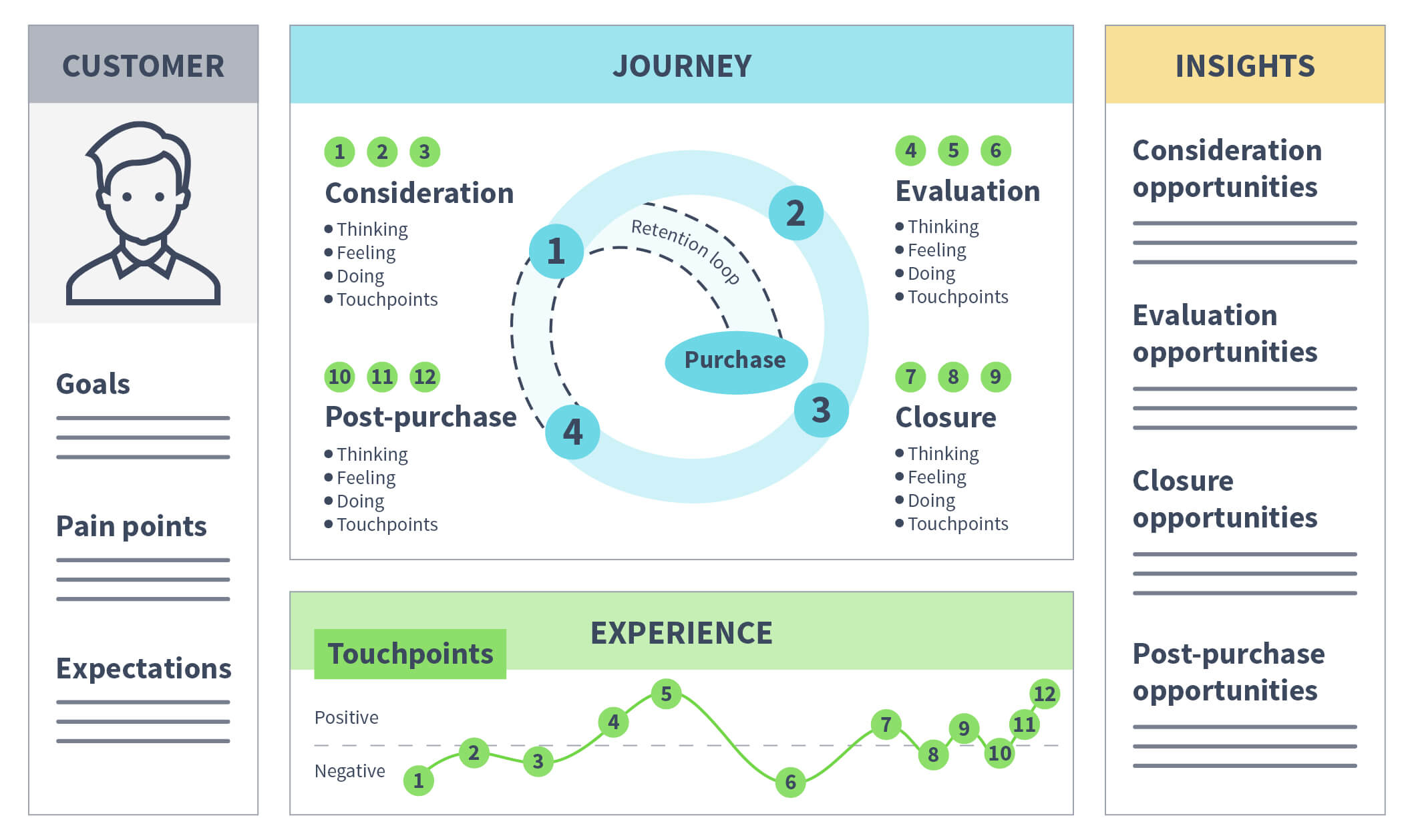
For the purposes of mapping out relevant content to the customer journey, it’s more helpful to consider the four major stages of the circular customer journey: consideration, evaluation, closure, and post purchase. Of course, you might find that your own customers go through fewer or more stages.
- Consideration
The consideration phase is kick-started by an initial trigger, where consumers explore their problem or inspiration. During this phase, consumers compare and consider a set of brands, based on the reputation of those brands, initial exposure to that set of brands, ads, recommendations, etc. This is the starting knowledge a consumer begins their journey with.
- Evaluation
In the evaluation stage, consumers continue their research on a deeper level. They’re adding and removing brands from their list, comparing products, gathering information, reading reviews, consulting sources they trust, and looking at pricing information. In larger organizations, evaluation is rarely one person’s job: legal, IT, procurement, and the team that will use the product each bring their own questions, and each needs content that answers them.
- Closure
The closure phase is defined by the moment of purchase. The customer has done their research, has likely talked to sales or consulted a trusted source and is now ready to make a decision.
- Post-purchase
The post purchase phase is everything that comes after the initial purchase, but before a second purchase or churn. In this stage, the customer is at their most critical or impressionable. They’re looking for the brand to deliver on the promise that was made about the product or service.
For each of these stages, use the learnings from your customer listening program to assess what your customers are thinking, feeling, doing, and the touchpoints they experience. Map out the touchpoints on a scale of negative to positive feelings.
This will help you identify areas where you can use content to solve problems, answer questions, provide inspiration, or put customers at ease. In essence, this helps you identify the gaps you have in relevant content, while also providing you a timeline for when it should be presented to a customer on their journey.
3. Decide what to personalize at each stage
Once you have a list of content opportunities for each stage in your customer journey, you need to decide what exactly changes from one stage to the next. Personalizing everything at once is how teams end up with dozens of variants and no clear sense of which ones matter. Instead, pick the one or two variables that make the biggest difference at each stage.
| Stage | What the reader needs | What to personalize | Example |
|---|---|---|---|
| Consideration | Recognize the problem and see that it’s solvable | Topic and framing, by role or industry | An industry-specific explainer on the problem |
| Evaluation | Compare options and build the internal case | Type and depth of proof, by stakeholder | Security documentation for IT, a cost model for finance |
| Closure | Remove the last remaining risks | Next step and reassurance | An implementation timeline, a reference customer in the same sector |
| Post-purchase | Get value quickly and justify the purchase | Format and sequence, by adoption progress | An onboarding checklist, a role-based training path |
- What will your audience find useful?
To truly provide value to your audience, you need to understand what they will find useful at this stage. Forget pushing your latest campaign or a specific offer. Focus on providing true value. Answer the questions and pain points you uncovered in your customer journey mapping process.
Once you have a working title and outline for your content, circulate it in your customer focus groups to see if it answers the questions or pain points customers have at that stage.
Create useful content by being very thorough. Provide actionable, concrete steps that lead your audience directly to the answers they’re looking for. Your audience shouldn’t have to look elsewhere for more information after reading or watching your content.
- Which formats are best suited to their questions and touchpoints?
Once you’ve identified what your audience will find useful, you need to figure out which formats to consider and how that fits with the touchpoints they experience at that particular stage in their journey.
For example, if you sell B2B software, you might find that customers in the post-purchase stage struggle to fully onboard their entire team to the tool. To address that, your content team might create an implementation package, which includes FAQs, thought leadership content on strategy, etc. Given those touchpoints and the value you’re trying to provide, you should consider video tutorials for your product, checklists to run through with a team new to your tool, downloadable templates for best-practices, etc. All of that can be sent with a personalized email that includes a video introduction that’s tailored to the unique stage in the journey your target audience is at.
For each piece of content, consider where in the journey your audience is at and how you can tailor format and touchpoints to address their needs.
4. Segment by role and need, not hobbies
Now that you’ve learned which types of content your audience wants to see and when, you can start to personalize it. Demographics and firmographics tell you who is reading. To create the most relevant content, you also need to understand why they’re reading.
- What are psychographics?
In short, psychographics is studying customers based on psychological characteristics, such as attitudes, values, desires, and motivations.
Traditionally, marketing teams have used demographics as a way to segment their audience. While demographics can generally explain some preferences and behaviors, they don’t give marketing teams deep insights into their audience’s motivations—that’s where psychographics come in.
If demographics is who your audience is, then psychographics is why your audience does what they do. In a business purchase, the most useful “why” is professional: what the reader is accountable for, what they’re worried about, and who else has to agree.
- How to collect motivation data
Start collecting this data in easy-to-execute ways, so your team has data to get started with. There are a few simple ways to start:
- Collect this data in your customer focus groups
- Follow up with the customers your team meets when they sit with the CS team and interview customers 1-1
- Send out customer surveys
- Interview your sales team and product matter experts about what customers really care about within the product and buying cycle
When interviewing or surveying customers, ask questions that get to the heart of what they care about at work, such as:
- What is your team responsible for this year, and how is that measured?
- What would make this purchase a risk for you personally?
- Who else has to agree before a decision moves forward?
- What information did you need during your evaluation that you couldn’t find?
- Which constraints (regulation, security review, budget cycle) shape how you buy?
- What would success look like six months after purchase?
- Be deliberate about the data you use
There’s a fine line between content that feels helpful and content that feels like surveillance. Personalization doesn’t have to mean flexing all the data you have on an individual customer—it can simply be understanding where an individual is at on their journey and how you can best provide value in a tailored and relevant way.
Personalization built on consented, first-party data also holds up better under privacy regulation than inferences gathered from third parties. In regulated industries, that matters more than anywhere else, as financial institutions are finding with cookieless personalization in financial services.
5. Personalize at scale without variant sprawl
Every personalized variant is another page, email, or module someone has to keep accurate. Ten segments across four stages is forty versions of the truth, and the more of them there are, the more likely one is out of date, off-brand, or inaccessible.
Two habits keep this manageable. First, build content in modules: a shared core that stays the same for everyone, with a small number of personalized blocks around it, such as the introduction, the proof point, or the next step. You can create personalized content at scale by recombining modules rather than rewriting whole assets.
Second, hold every variant to the same standard as the original. A personalized page should go through the same accessibility, accuracy, and brand checks as the page it was built from. In healthcare, financial services, and government, a stale variant is more than a quality problem, because it can put inaccurate or non-compliant information in front of exactly the people it was tailored for.
6. Measure what works at each stage
As you create more relevant and well-timed content, you can start to collect data on which pieces of content have higher rates of success at each stage in the customer journey. Measure each stage against its own goal rather than one conversion rate for everything:
- Consideration. Are the segments you targeted finding the content, and do they come back?
- Evaluation. Which content do people consume in the weeks before they contact sales or request a demo?
- Closure. Which pieces appear most often in the journeys that end in a purchase?
- Post-purchase. Does onboarding content reduce support tickets and speed up adoption?
Based on those success rates and the feedback your focus groups give you, your team can start to better predict the types of content your audience would like to see next.
Surprise and delight your audience by answering their questions and addressing their needs before they become serious roadblocks on their journey.
Learn more
Personalizing content for every stage of the customer journey depends on two things: content that stays accurate and on-brand as variants multiply, and data that shows which content moves people forward.
Siteimprove.ai Content Strategy turns a brief into an on-brand draft with built-in governance for voice, quality, and visibility, and Siteimprove.ai Analytics answers plain-language questions about traffic, behavior, and ROI. Request a demo to see both in action.